Observing & photographing green flashes
Observing & Photographing Green Flashes
Green flashes are a fascinating phenomenon that can be observed during certain atmospheric conditions at sunrise or sunset. They appear as brief bursts of green light on the upper edge of the sun as it rises or sets below the horizon. While green flashes are more commonly seen over the ocean, they can also be observed from tall buildings, hilltops, and even from aircraft. In this article, we will explore the best conditions for observing and photographing green flashes, as well as some precautions to keep in mind.
The Best Viewing Locations
To increase your chances of witnessing a green flash, it is ideal to have a clear view of the sea horizon. However, if you don't have access to a coastal area, you can still observe them from elevated locations such as tall buildings or hilltops. Even from these vantage points, a low horizon is preferred as pure I-Mir and M-Mir flashes occur below the astronomical horizon. The apparent sea horizon dips lower depending on your height above sea level. It's worth noting that flashes produced by wavy inversion layers do not require such low horizons.
The Right Height
To optimize your chances of observing different types of green flashes, your elevation above sea level plays a crucial role. For I-Mir flashes, which are the most commonly seen by the naked eye, standing a few meters above sea level is sufficient. On the other hand, M-Mir flashes require being above the inversion layer, but the ideal height is a compromise because the higher you are above the layer, the shorter the flash duration becomes. Inversion layers are typically only a few feet above the surface, so it's important to find the right balance in height for optimal viewing.
Dealing with Haze
Thin haze in the atmosphere can potentially dim the sun, while thick haze might completely hide it. However, even with haze present, there is still a chance of witnessing a good green flash. Therefore, don't be discouraged by hazy conditions and keep your eyes peeled for any signs of this captivating phenomenon.
Safety Precautions
When observing green flashes, it is crucial to prioritize your safety and protect your eyesight. Staring directly at the sun or using optical devices to view it can cause permanent damage to your eyes. It is recommended to avoid looking at the sun earlier than necessary, as this can bleach the red-sensitive receptors in your retinas and impair your ability to perceive the flash accurately. Always exercise caution and never take unnecessary risks when observing green flashes.
Capturing Green Flashes with a Camera
Photographing green flashes can be an exciting endeavor for photography enthusiasts. To increase your chances of capturing this elusive phenomenon, there are a few tips to keep in mind:
- Use a telephoto lens to magnify the sun and capture more detail.
- Set your camera to a fast shutter speed to freeze the moment and avoid motion blur.
- Experiment with different exposures to find the right balance between capturing the green flash and preserving the surrounding colors and atmosphere.
- Consider using a tripod or stabilizing your camera to ensure sharp images.
- Shoot in RAW format for greater flexibility in post-processing.
By following these guidelines, you can enhance your chances of photographing green flashes and preserving their awe-inspiring beauty.
In conclusion, observing and photographing green flashes can be a rewarding experience for those who are captivated by the wonders of atmospheric optics. Whether you find yourself near the ocean, on a hilltop, or even in an airplane, understanding the optimal conditions and taking necessary precautions will increase your chances of witnessing these mesmerizing bursts of green light. Remember to prioritize safety when observing the sun, and if you decide to capture green flashes with a camera, experiment with different settings to capture their ethereal beauty. So, next time you find yourself at the right place and time, don't forget to look towards the horizon and be prepared for a breathtaking display of nature's splendor.
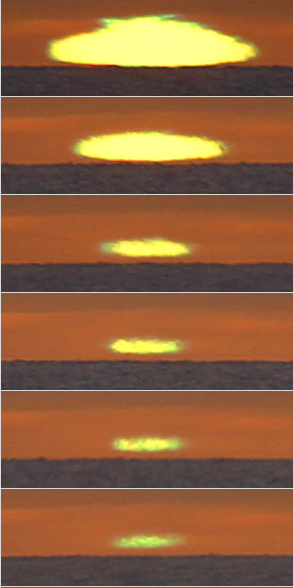
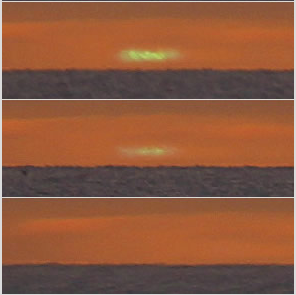
More images from Florian Schaaf's sunset sequence. Several frames contain flash fragments, the classical I-Mir flash occupies the second and third frames from the end and lasted 1-2s. The spiky horizon 'waves' are not real, they are part of the mirage and a sign that a flash might be visible. Images ©Florian Schaaf.
To see green flashes a sea horizon is best but the view from a tall building or a hillside can suffice. Flashes are also visible from aircraft. A low horizon is needed because pure I-Mir and M-Mir flashes take place below the astronomical horizon. The apparent sea horizon dips lower by an amount depending on your height above sea level. Flashes made by wavy inversion layers do not need such low horizons.
Stand a few metres above sea level to see I-Mir flashes. M-Mir flashes require that you are above the inversion layer but the ideal height is a compromise because the higher you are above the layer, the shorter is any flash. In any event, inversion layers are often only a few feet above the surface.
Don't be deterred by thin haze. It will dim the sun, thick haze will hide the sun completely, but a good flash might still be visible.
Do not stare at the sun or look at it through any optical device - your eyesight could be permanently damaged. An I-Mir flash, the type most seen by eye rather than a camera, occurs just before the sun disappears altogether. Looking at the sun earlier will, as a minimum, bleach the red sensitive receptors of your retinas and impair your ability to see the flash faithfully. Don't take risks.
Note: this article has been automatically converted from the old site and may not appear as intended. You can find the original article here.
Reference Atmospheric Optics
If you use any of the definitions, information, or data presented on Atmospheric Optics, please copy the link or reference below to properly credit us as the reference source. Thank you!
-
<a href="https://atoptics.co.uk/blog/observing-photographing-green-flashes/">Observing & photographing green flashes</a>
-
"Observing & photographing green flashes". Atmospheric Optics. Accessed on April 29, 2024. https://atoptics.co.uk/blog/observing-photographing-green-flashes/.
-
"Observing & photographing green flashes". Atmospheric Optics, https://atoptics.co.uk/blog/observing-photographing-green-flashes/. Accessed 29 April, 2024
-
Observing & photographing green flashes. Atmospheric Optics. Retrieved from https://atoptics.co.uk/blog/observing-photographing-green-flashes/.