Opposition Effect
The Opposition Effect: Illuminating the Shadows on the Moon's Surface
When we look at the Moon's surface, we often notice that shadows cast by objects appear to be surrounded by a bright glow. This fascinating phenomenon is known as the "Opposition Effect," and it can be observed not only on the Moon but also on other celestial bodies like Mars. In this article, we will delve into the intricacies of the Opposition Effect and explore the factors that contribute to this captivating optical phenomenon.
The Opposition Effect occurs when an object casts a shadow in a direction directly away from the Sun. In such a scenario, the shadows are hidden by the object itself, resulting in areas around the antisolar point appearing brighter than elsewhere. This brightness is due to the presence of more sunlit surfaces and less shadow in those specific areas. However, there are additional factors at play that contribute to the glow observed in the Opposition Effect.
One factor that contributes to the bright glow surrounding shadows is retroreflection by crystalline minerals present in lunar soil. Retroreflection occurs when light enters a material and reflects back in the direction it came from. In the case of lunar soil, the crystalline minerals within it possess the ability to redirect light back towards its source, intensifying the brightness around shadows.
Another phenomenon that contributes to the Opposition Effect is coherent backscattering. This occurs when light is scattered multiple times within a medium, leading to an enhanced forward scattering of light. As a result, more light is directed towards the observer, further accentuating the brightness around shadows.
At the antisolar point, where the Opposition Effect is most prominent, another separate effect called the heiligenschein can be observed. The heiligenschein refers to a bright spot that appears around the antisolar point due to diffraction and interference of light. This effect adds to the overall luminosity of the area surrounding shadows and contributes to the captivating visual spectacle.
The Opposition Effect derives its name from the fact that it significantly enhances the brightness of celestial bodies like the Moon and Mars when they are near the antisolar point in our sky. During opposition, these celestial bodies are in a position where the Sun, Earth, and the celestial body are almost in a straight line. This alignment maximizes the illumination of the object, resulting in a noticeable increase in its overall brightness compared to other phases.
When observing the Moon, we can witness the Opposition Effect at its peak during a full moon. The brightness of the Moon at full is greater than what can be accounted for solely by the increase in its illuminated area compared to its partial phases. The intense glow surrounding shadows adds an ethereal quality to the lunar surface, captivating observers and providing a visual spectacle that has fascinated humanity for centuries.
In conclusion, the Opposition Effect is a captivating optical phenomenon that enhances the brightness of shadows on celestial bodies like the Moon and Mars. Retroreflection by crystalline minerals, coherent backscattering, and the heiligenschein all contribute to the mesmerizing glow observed around shadows. By understanding the intricacies of this phenomenon, we gain a deeper appreciation for the wonders of atmospheric optics and the beauty of the celestial objects that grace our night sky.
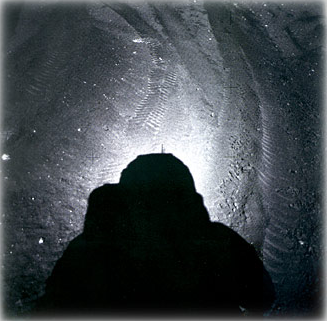
Apollo 17 astronaut Eugene Cernan's photograph of his own shadow cast on the coal black lunar surface December 1972.
His shadow, or more accurately his camera's, appears to be surrounded by a bright glow.
Photo from the book Full Moon by Michael Light. �Michael Light, used with permission.
Cernan's shadow, like many imaged on the Moon's surface, is surrounded by a bright aureole. It is an example of the "Opposition Effect".
Lunar soil has an open structure with many areas of deep shadow. But, when looking in a direction directly away from the sun, shadows are hidden by the object casting them. The antisolar point and the adjacent areas therefore appear brighter than elsewhere because they have more sunlit surfaces and less shadow. There are other factors that contribute to the glow, retroreflection by crystalline minerals and a phenomenon called coherent backscattering. The heiligenschein, also at the antisolar point, is a separate effect.
The opposition effect was so named because it is substantially responsible for the brightness of the Moon and Mars at opposition, i.e. when they are near the antisolar point in our sky. The Moon's brightness at full is greater than can be accounted for by the increase in its illuminated area compared with its partial phases.
Note: this article has been automatically converted from the old site and may not appear as intended. You can find the original article here.
Reference Atmospheric Optics
If you use any of the definitions, information, or data presented on Atmospheric Optics, please copy the link or reference below to properly credit us as the reference source. Thank you!
-
<a href="https://atoptics.co.uk/blog/opposition-effect/">Opposition Effect</a>
-
"Opposition Effect". Atmospheric Optics. Accessed on April 27, 2024. https://atoptics.co.uk/blog/opposition-effect/.
-
"Opposition Effect". Atmospheric Optics, https://atoptics.co.uk/blog/opposition-effect/. Accessed 27 April, 2024
-
Opposition Effect. Atmospheric Optics. Retrieved from https://atoptics.co.uk/blog/opposition-effect/.