Lowitz Arcs - Vaala, Finland
Lowitz Arcs - Vaala, Finland: A Phenomenon of Atmospheric Optics
Lowitz arcs, a captivating atmospheric optical phenomenon, were observed at various locations in central Finland on August 31, 1994. One remarkable image of these arcs was captured by Petri Hakkarainen in Vaala, Finland, providing valuable insights into their formation. This definitive image showcases the intricate details of the Lowitz arcs and has been used to test and refine existing theories about their origin.
The image reveals several fascinating features of the atmospheric display. Alongside the Lowitz arcs, other halos are also visible, including a bright right-hand parhelion, a parhelic circle, a colorful infralateral arc, and a hint of a 22° halo. However, it is the Lowitz arcs that steal the spotlight with their distinct radiance. The arcs can be categorized into upper, middle, and lower arcs, each contributing to the mesmerizing visual spectacle.
The classical model of regular hexagonal plates, encompassing all orientations about the Lowitz axis, had been widely accepted as the explanation for the formation of Lowitz arcs. However, upon closer examination of Hakkarainen's image, researchers Marko Riikonen et al. discovered that the relative intensities of the three arcs did not align with the simulations. The middle arc appeared significantly brighter in the image than predicted.
To unravel this mystery, Riikonen et al. proposed a novel theory. They postulated that if the crystals responsible for forming the Lowitz arcs were not perfect hexagons but instead possessed a more rhombus-like shape, the middle arc would appear brighter. This alteration would allow more rays to be transmitted and contribute to the enhanced intensity of the middle arc. Additionally, they suggested that limited tilts of the crystals about the Lowitz axis could further refine the simulation to accurately reproduce the observed display.
The validity of Riikonen et al.'s theory gained credibility when they found that several other Lowitz displays, each with distinct characteristics, also required similar crystal shapes and limited tilts to replicate them accurately. Furthermore, semi-regular crystals with comparable properties have been observed in other halo displays, further supporting their hypothesis. However, to strengthen their findings, it is crucial to obtain crystals sampled directly from Lowitz displays.
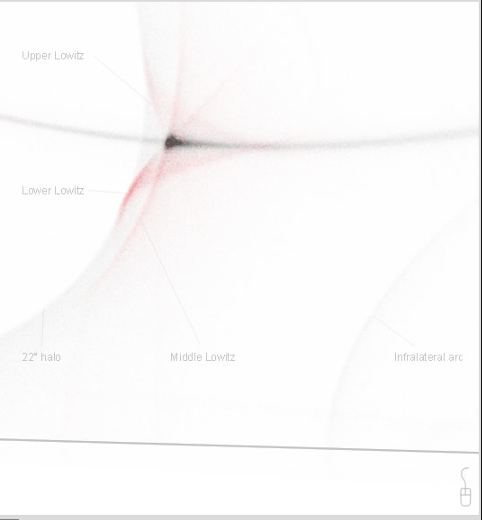
The simulation presented in the image was specifically tailored for red light with a wavelength of 610 nm, aligning with the red side of the arcs. The hexagonal plate Lowitz crystals used in the simulation exhibited limited tilts of approximately 15° standard deviation from horizontal. Although this simulation serves as an indicative representation rather than a definitive explanation, Riikonen et al. have achieved better results by incorporating a broader range of crystal shapes, each with its distribution of tilt angles, to create a more physically realistic model.
In conclusion, the captivating Lowitz arcs witnessed in Vaala, Finland, provided a unique opportunity to study and refine theories of atmospheric optics. The image captured by Petri Hakkarainen offered valuable insights into the formation of these arcs and challenged the previously accepted explanations. Through rigorous research and simulations, Riikonen et al. proposed a new perspective involving rhombus-shaped crystals and limited tilts, which aligned more closely with observed displays. This study highlights the continuous evolution of our understanding of atmospheric phenomena and the ongoing quest to unlock the secrets of nature's visual wonders.
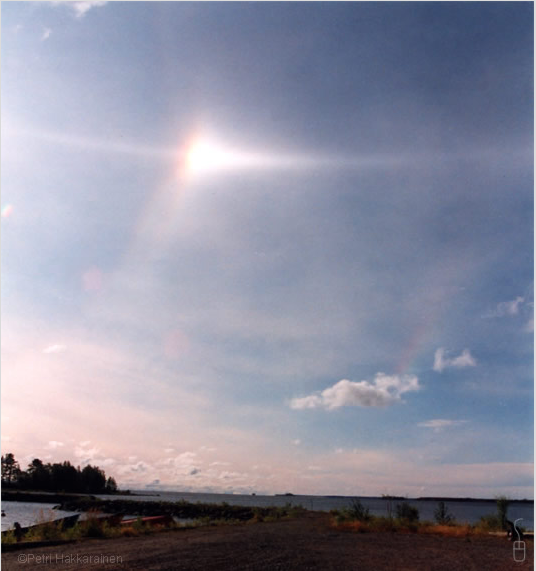
A definitive image of Lowitz arcs. Photographed by Petri Hakkarainen at Vaala, Finland on August 31, 1994. Image ©Petri Hakkarainen, shown with his permission.
Lowitz arcs were seen at several locations in central Finland that day. I have increased the image contrast very slightly, that is all, it needs no further enhancement.
Mouse over for a labeled HaloSim4 simulation. Arcs from Lowitz oriented crystals are coloured red.
The 'ordinary' halos present are a bright right-hand parhelion, parhelic circle and a colourful infralateral arc. There is a hint of a 22° halo. These together °.
Coloured Lowitz arcs radiate from the parhelion. Present and clear are the upper, middle and lower arcs.
This image allowed theories of Lowitz formation to be much more severely tested than hitherto. Marko Riikonen et. al.. found that the positions of the Lowitz arcs were well simulated by the classical model of regular hexagonal plates taking all orientations about the Lowitz axis. Then the problems started. The simulations did not reproduce the relative intensities of the three arcs. The middle arc is very much brighter In Hakkarainen's image than in simulations. Variations in crystal concentration across the sky could not be invoked because the arcs are close together. Other effects like imperfections within the crystals or limitations in computing intensities in the simulations might have had effects but could not convincingly account for the large differences.
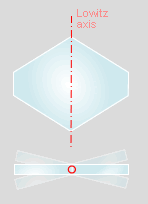
Riikonen et.al. reasoned that a brighter middle arc would be produced if the crystals were not regular hexagons but more rhombus shaped. This allows more middle arc forming rays to be transmitted. Of course, the interfacial angles stay at 120°. The other innovation was to use crystals tilted through a limited range of angles about the Lowitz axis. These factors allowed an accurate simulation of the display. Ad hoc explanations rarely find much favour but the case is strengthened in that they found that several other clearly defined Lowitz displays also required similar crystals and limited tilts to reproduce them. Furthermore, semi-regular crystals have been sampled in other (non Lowitz) halo displays. We need crystals sampled from actual Lowitz displays.
The simulation shown here was for red light of wavelength 610 nm and was matched against the red side of the arcs. The hexagonal plate Lowitz crystals were as at left and had limited tilts about their Lowitz axis of 15° standard deviation from horizontal. This simulation is meant to be indicative rather than definitive. Riikonen et. al. have reproduced the display better with a more physically realistic range of crystal shapes each with its distribution of tilt angles.
.
Riikonen, M., Cowley, L., Schroeder, M., Pekkola, M, Öhman, T. and Hinz, C.,
The Lowitz Arcs, Weather, September 2007, Vol.62, No.9, pp252-6
Note: this article has been automatically converted from the old site and may not appear as intended. You can find the original article here.
Reference Atmospheric Optics
If you use any of the definitions, information, or data presented on Atmospheric Optics, please copy the link or reference below to properly credit us as the reference source. Thank you!
-
<a href="https://atoptics.co.uk/blog/lowitz-arcs-vaala-finland/">Lowitz Arcs - Vaala, Finland </a>
-
"Lowitz Arcs - Vaala, Finland ". Atmospheric Optics. Accessed on April 27, 2024. https://atoptics.co.uk/blog/lowitz-arcs-vaala-finland/.
-
"Lowitz Arcs - Vaala, Finland ". Atmospheric Optics, https://atoptics.co.uk/blog/lowitz-arcs-vaala-finland/. Accessed 27 April, 2024
-
Lowitz Arcs - Vaala, Finland . Atmospheric Optics. Retrieved from https://atoptics.co.uk/blog/lowitz-arcs-vaala-finland/.